Craft, production, and the journey from screenplay to screen.
How to Write Great Dialogue and Subtext
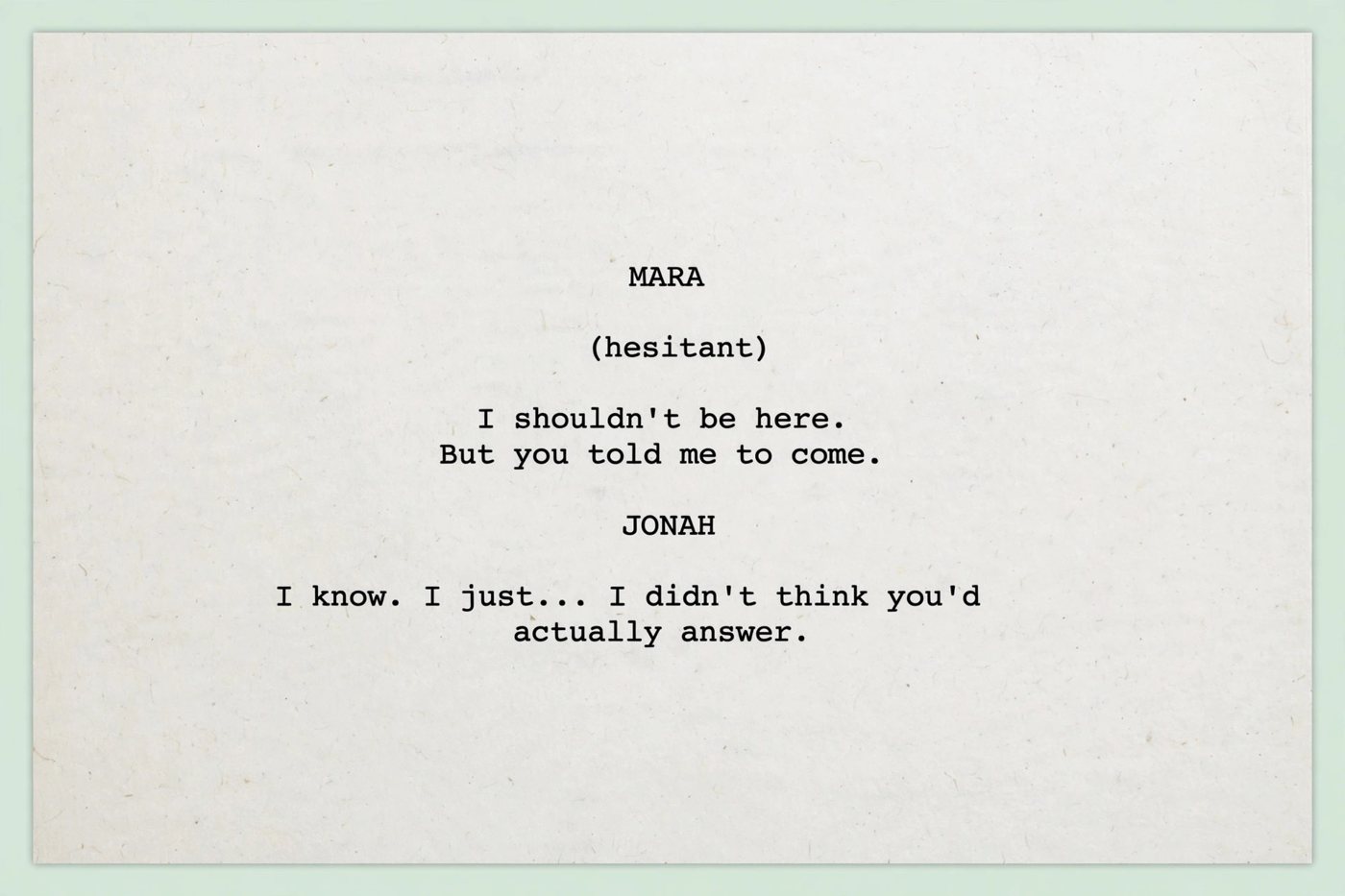
Dialogue is the words characters say, the literal lines an actor reads in the script. But under those words lives much more: exposition, emotion, tone, character, plot, or all of these things at once. What a character says, or how little they say, tells you who they are, what they think, how they feel, and why they changed. Think of Charlize Theron's Furiosa in Mad Max: Fury Road, who barely speaks, or Clint Eastwood's Man With No Name. The silence is part of the dialogue too.
The best dialogue is rarely about what the scene is about. That gap, between what a character says and what they mean, is subtext, and it is the single most important tool in a dialogue writer's kit. Here is how to build it.
What subtext actually is
Subtext is the distance between what a character says and what they actually mean or want in that moment. It is not mumbling, mystery, or characters being coy for the sake of it. It is an intentional use of space. Dialogue feels alive when that space is there, and expository when it is not. That is the way we speak in real life. We do not say everything all the time, and we do not need to. Why should your characters be any different?
When every character says exactly what they want, out loud, in full sentences, the scene falls flat. The plot can be on point and the scene can still feel dead, because there is nothing for the audience to discover. Subtext is what lets the audience discover it.
Start with the want, not the line
Before you write what a character says, write what they want from the other person in this scene. Not what they want from the story. What they want from the person in front of them, right now. Approval, forgiveness, an exit, an apology they would never ask for, a reason to stay angry.
Then write the line that does the opposite of announcing the want. A character who wants forgiveness asks if the other person has eaten. A character who wants out talks about logistics. A character who is afraid gets very interested in the details of something irrelevant. None of these lines says what the character wants, but each one is specific to getting it. The character who wants forgiveness is not asking for it. They are setting up a meal, a conversation, a moment where trust can return. The want stays under the surface, and the audience reads it from the space in the things left unsaid.
Give them a reason not to say it
Subtext only works when a character has a believable reason to avoid the direct line. Pride, fear, politeness, strategy, timing, power. If there is no pressure on the character to hold back, a smart one would simply say the thing, and the evasion will read as a writer trying to be clever.
When you are looking at a scene, ask what it would cost this character to say what they want plainly. If the answer is nothing, then the line probably should be said plainly. If the answer is her job, his marriage, their safety, everything, now you have found where the subtext lives.
The surface conversation must be real
The strongest subtext scenes have a surface conversation that is a real conversation. Two people arguing about who forgot to buy milk should be fully believable as two people arguing about milk. The deeper argument rides underneath it, and the audience feels both at once. When the surface topic is obviously a stand in, the scene tips into a metaphor wearing a costume.
This is where writers go wrong. They reverse engineer a scene from one great subtext moment at the end, and everything leading up to it turns into flat dialogue written only to get there. Build the surface first. Make it true. Then let the underneath do its work.
Short, purposeful, and paced like a dance
Great dialogue is generally short and sweet. You only have so much space in a screenplay, so imbue every word with meaning. Amateur writers afraid of blank space often have characters drone on without actually saying anything. A monologue can be fun, especially for villains, but it should be a garnish, not the main ingredient. What you want on the page is a lot of white space, because it is easy on the eye for readers. Large chunks of text encourage people to glaze over or skim.
Dialogue should almost be like a dance. It does not have to all be quick and snappy, but there should be a rhythm. That rhythm can and should shift: rise and fall, give and take, receive and send back, depending on the scene. People do not just talk at each other. They respond. Study repetition, interruption, and back and forth. David Mamet's Glengarry Glen Ross is the masterclass: people talking over each other, finishing each other's sentences, and saying everything except the thing that matters.
Every character needs their own voice
If you covered up the names in your script, would you know who everyone is just by the way they talk? Each character should have a well defined voice. That does not just mean an accent. Consider backgrounds and beliefs. A steelworker from Pennsylvania sounds different from a finance worker in New York City. Graham Yost's series Justified gives the example: Raylan Givens and Boyd Crowder grew up together in eastern Kentucky, but Raylan is direct while Boyd is verbose. Same place, different voices.
Point of view is part of voice. What we do or do not say defines who we are. All of your characters should have a unique point of view on the world, and their dialogue should reflect that. If everyone is agreeing with each other all the time, there is no story.
Kill the exposition dump
A cardinal sin of dialogue writing is having characters explain background or context information for long stretches. It becomes dry and uninteresting. The best way to establish context and backstory is through comedy or conflict. Show, do not tell. Couch your context in a snarky quip or a joke, or through an argument.
The same rule applies to filler words. Yes, people say um, uh, and like in the real world. On the page, over relying on them comes off as awkward and dull, and worse, as over directing the actor. If your dialogue is well written, an actor will know when to add a pause or a stammer. The only reason to include a filler word is when it means something specific, like an um that shows a character inventing a lie on the spot.
The one question test
Take any line of dialogue and ask: could anyone say this, anywhere, in any scene? We need to talk. I just want what is best for you. You never listen to me. Lines like these travel. Swap in any pair of characters and any situation, and they still work. That is the sign they are doing no double duty. They carry information and likely nothing else.
Now rewrite the line so that only this character could say it, in this exact situation, to this exact person. It will almost always get more specific, maybe a little oblique, and often shorter. A line that only this character could say, at only this moment, almost always carries subtext, because specificity forces a point of view.
Ask that question across an entire scene and mark every line that could be said anywhere. In most drafts, those lines cluster where the script is explaining itself: setup scenes, emotional turning points, and the moments right before a big decision. That is where to look first.
Subtext is precise, not vague. The writer always knows exactly what is underneath, and the scene gives the audience enough to find it: a loaded pause, a subject change at the wrong moment, a line that answers a different question than the one asked. Here is the check: could you explain, in one sentence, what each character means in this exchange? If you can, and the page does not say it out loud, you have subtext. If you cannot, you have fog.
Know when to say it plainly
None of this means every line must hide under subtext. Some moments earn the direct statement, and often the strongest line is the one the whole scene has been avoiding. A character who has held back for forty pages and finally says the thing straightforward lands far harder than one who says everything out loud from the start. Subtext is what makes that plain line hit when it comes. Think of the quietly devastating declarations of love in Casablanca, or the spare, loaded kitchen table exchanges in Manchester by the Sea. The plain line works because of everything the dialogue has been carrying around it up to that moment.
The writers on Mad Men were masters of this. In the season one finale, Don Draper pitches Kodak's slide projector by selling nostalgia with happy family photos, while the audience knows his own life is nothing like the pictures. He says one thing. The scene means the opposite. That is subtext doing its job.
Try this before your next draft
Pick three scenes where the emotion is highest. For each one, write down what each character wants from the other person. Then read the dialogue aloud and mark any line that states that want outright. Rewrite those lines so the want is still there but the character has a reason not to say it. Finally, run the one question test on what is left. You will likely cut lines, and the scenes will probably get shorter and sharper. If a scene will not move at all, here is how writers get through creative blocks.
Read the scene out loud when you are done. Does it sound right? Go to a coffee shop, close your eyes, and listen to how real people talk. When Martin Scorsese and Mardik Martin were writing Mean Streets, they would sit at a cafe and absorb the sounds of Little Italy. Train your ear the same way. Dialogue that sounds like people is dialogue that works.
Where GREENLIGHT fits
GREENLIGHT is a script editor built to support the writer. When you are blocked on a scene, bring the scene to Guide. Guide questions it the way a good teacher does: what does each character want in one plain sentence, why this line and not the opposite, what is the scene avoiding. Each question gives you a new angle on the scene, so you keep going. Guide never writes the story for you. Every choice stays yours. Open your script in the editor and ask Guide what your scene is really about. The creator owns the story at every stage.
Sources
Write the movie. Understand the movie. Plan the movie. Sell the script.
GREENLIGHT is a filmmaking and screenplay development platform where the creator owns the story. Start creating • Learn in the Academy • See how discovery works